


Beyond Green Growth
Updated: Dec 3, 2025
Lessons from Ladakh’s Planet Local Summit
This piece is dedicated to the inspiring fight of noted climate activist Sonam Wangchuk, whose longstanding work has challenged India’s extractive development paradigms and mobilized public consciousness toward planet-friendly alternatives while reclaiming ecological and cultural autonomy. Mr. Wangchuk attended Ladakh’s Planet Local Summit, but shortly thereafter was arrested under the National Security Act (NSA) in an unjust and disproportionate manner. At a time when the Indian Government, led by the climate-denialist and increasingly totalitarian Bharatiya Janata Party (BJP) regime, continues to suppress all forms of dissent, his baseless arrest reflects a deeper pattern of criminalizing ecological advocacy as well. I therefore take this occasion to register my unequivocal and urgent demand for his immediate release!
Introduction: Visiting Ladakh for the Planet Local Summit
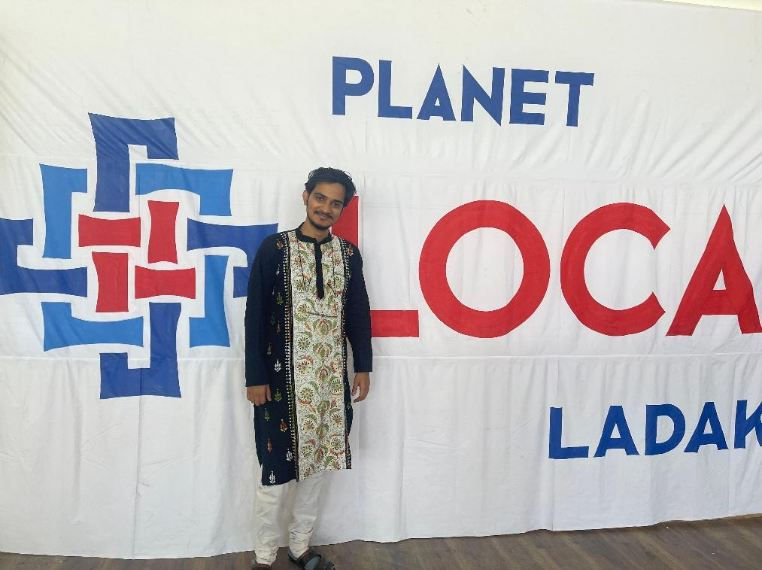
A few months ago, I was invited to attend the Planet Local Summit (3-7 September, 2025) in Ladakh, India. It was organized by Local Futures headed by Helena Norberg-Hodge along with a number of teams working together in harmony to instate participatory, collective leadership goals. Having known Helena since my time as a student at Schumacher College, I was especially eager to witness firsthand the kind of localization work her organization has been championing in Ladakh. Her celebrated book and documentary, Ancient Futures (1991), provide the framework for a vision of systemic, community-driven resilience, serving as an alternative to the techno-economic system of globalization. While the global system thrives on debt traps, deregulation, consumerism, and domination, the local approach is rooted in the decentralized economics of happiness that can never be measured in GDP. This approach resonates with Bhutan’s model, which emphasizes “Gross National Happiness” (GNH) over GDP — prioritizing holistic well-being and ecological equilibrium instead of mere economic expansion.
It is to be noted that what this summit offered was not the co-opted “localization” of an “HSBC Local,” but a genuine, systemic localization—one that, in practice, challenges the entrenched structures of domination that perpetuate both genocides and ecocides. Such systemic localization is put into practice through the lens of what Helena calls “Big Picture Activism”: reflect globally, act locally.
The Local Futures initiative shares its ethos with many ongoing bioregional initiatives, local food movements, save soil/save seeds initiatives, moneyless society experiments, ecoversities, farmversities, transition towns, intentional community networks and regenerative agriculture movements taking place right now all around the world, especially across the Global South.
Upon arriving in Ladakh, I was instantly captivated by its breathtaking landscape and the warmth and wisdom of its people. Often called “Little Tibet,” Ladakh lies within the greater Himalayan region—the “Third Pole” of the world—holding vast glacial reserves vital to regional and global climate stability. Yet this high-altitude desert faces severe climate threats: rapid glacial melt, shrinking snow cover, desertification, erratic weather, and water insecurity. Its fragile ecosystems, biodiversity, and traditional pastoral-agrarian livelihoods are under immense strain from rising temperatures, unplanned infrastructure, and extractive “developmental” projects. Any disturbance to Ladakh’s ecological balance endangers not only local life but also downstream agriculture, water security, and climate resilience across South and Central Asia. Safeguarding Ladakh’s environment is thus a global imperative—an ethos central to the Summit I attended.

The Summit reminded us that the solutions to the world’s complex “polycrisis” challenges are often disarmingly simple—rooted in the basic human needs for food, clothing, and shelter. Yet, as the changemaking pilgrim Satish Kumar reminds us, sustained well-being also lies in nourishing both the human and more-than-human spirits through the practice of radical love. Engaging face-to-face with changemakers from around the world during this summit highlighted the importance of horizontal, “fungi-like” networking (or what Gandhi called “Oceanic Circles”) across localization movements—an “inter-local” or “trans-local” reckoning that enables these initiatives to flourish, connect, and hold space for one another, instead of becoming isolated islands or “bubbles” within, say, a 50-mile radius.
Through this short article, I aim to share recurring insights and reflections from my dialogues at the summit: the perils of supposed “green growth” and the place-based practices that inspire hope through resilient action. What follows is a summarized combination of what I observed, what unsettled me, and what renewed my faith in futures built on the deep ecological wisdom of collective imagination, humility, compassion, and creative regeneration.
The Four Warnings: Green Growth as Climate Colonialism
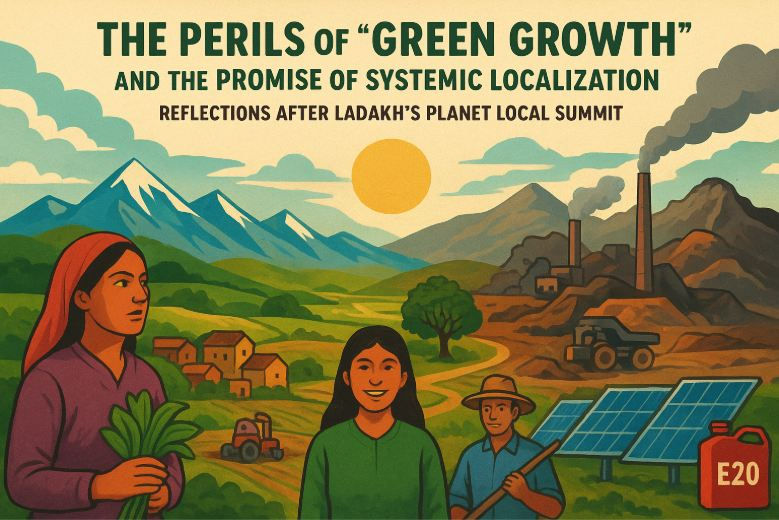
The age of “green growth” arrives cloaked in optimism: net zero, renewables, critical minerals, biofuels. Yet beneath the promises, old extractive logic often persists. Certain projects framed as planetary salvation frequently replicate colonial patterns of resource extraction. Four exemplary cases—the National Critical Mineral Mission in India, nickel mining in Indonesia, the solar park in Ladakh’s Changthang, and India’s E20 petrol rollout—illustrate this pattern.
a) First Warning: India’s National Critical Mineral Mission (NCMM)
In January 2025, India launched its National Critical Mineral Mission with ₹34,300 crore to accelerate exploration, mining, processing, and recycling of “green minerals” like lithium and cobalt. While energy independence is the stated goal, the reality is a rush to mine ecologically sensitive zones, including Jammu & Kashmir. Land and minerals are treated as national assets to be unlocked, with social and environmental safeguards secondary.
The shift is cosmetic: oil and coal are out, lithium and cobalt are in, but the extractivism remains unchanged. It is curious that I became aware of this “Mission” while I was preparing for an invited virtual talk at the Pan-African Peace and Climate Justice Youth Summit in Kenya, headed by Fridays for Future, the Northern Arizona Climate Change Alliance (NAZCCA), and others. This talk occurred just two days before I ventured out for the Ladakh Summit.
b) Second Warning: Indonesia’s Nickel and Deforestation
Indonesia, holding 22% of global nickel reserves, has become central to the EV revolution. In Halmahera’s Weda Bay, over 5,300 hectares of forest have been cleared since 2018, emitting more than 2 million metric tons of CO₂ equivalent. Deforestation disrupts ecosystems, water systems, and local livelihoods, while global North markets profit in neo-imperialist fashion. This mirrors historical colonial trade: extraction in the Global South, profit in the North, “costs” externalized.
I became aware of this during my conversations with a few members of the Pagdandi collective during the Ladakh summit. This particular collective aims to bring forth ways of knowing rooted in local surroundings and creative urges, rather than mass-produced rote learning of factory-education systems. Such modes of learning through living are crucial not only for environmental literacy, but for reclaiming our planetary interconnectedness during the climate crises.
c) Third Warning: India’s E20 Petrol Rollout
While the summit was taking place in Ladakh, a “green scam” was unfolding in India’s political economy. The nationwide introduction of E20 petrol—a blend of 80% petrol and 20% ethanol—illustrates greenwashed cronyism. Large-scale ethanol production, reliant on sugarcane and grains, intensifies food-versus-fuel conflicts, groundwater depletion, and monoculture expansion. Politically connected firms, including those linked to Union Minister Nitin Gadkari’s family, have disproportionately benefited. Centralized agro-industrial biofuels are prioritized over decentralized renewables, reinforcing extractive, top-down logic and locking India into short-term carbon-intensive fixes.
d) Fourth Warning: The Solar Park in Ladakh’s Changthang
Ladakh itself provided another warning. While talking to local shop-owners and other villagers in Ladakh, I found out about a solar project in the region, which is summarized below:
A 13 GW hybrid renewable park is coming up across 48,000 acres of the Changthang plateau. For planners, this is clean energy; for the Changpa nomads, whose existence depends on delicate high-altitude pastures and seasonal migratory routes, it threatens goats, livelihoods, and the fragile cold-desert ecosystem. Minimal consultation, vague compensation frameworks, opaque corporate involvement and tokenistic pilot projects only deepen the sense of dispossession. The project risks fencing off nearly 92 square miles (about 240 sq km) of land, disrupting traditional movement patterns and diluting Ladakh’s centuries-old goba system of self-governance that has long regulated grazing and community life. As elsewhere in Assam, Rajasthan, and Gujarat, land is once again rendered “empty,” communities rendered expendable, and ecological limits pushed aside in the name of green development.
What is striking is how this mirrors patterns across India’s so-called “green frontier.” Assam’s proposed 1,000 MW solar developments have provoked Indigenous opposition and protest over land rights and consent, while in Rajasthan mega-solar schemes have repeatedly threatened sacred groves or orans and pastoral commons; in Gujarat’s Rann of Kachchh (salt marsh region), large green-energy corridors have been accompanied by widespread reports of labour abuses and renewed dispossession for salt-pan workers and pastoralists. These parallel “green grabs” reveal a new phase of greenwashed developmentalism—carbon-neutral in rhetoric, colonial in structure.
During one of my personal conversations with Helena Norberg-Hodge, she duly noted:
“Be aware: this Changtang system is absolutely not about decentralised renewable energy. It is a mega-industrial attempt to produce energy for a corporate system—and its whole purpose is to export energy from Ladakh. Even things that look smaller, that appear to be about decentralisation, are still forcing people to feed a national—now usually more-than-national—grid.
That is the big danger. We need to see who is putting energy into the grid, and who controls it. These grids are now in the hands of giant global corporations that have more power than our governments, pushing them into debt and promoting an infrastructure that serves extractive global capitalism—an economy benefiting fewer and fewer people, a shrinking handful of billionaires, soon to become trillionaires.
Over these fifty years, I’ve watched how the energy side was co-opted very early on. We began with renewable energy in Ladakh and Bhutan, and I saw it being taken over. What I’ve found is that food initiatives are far more fundamental in shifting real power. By transforming farms toward diversified production for needs closer to home, people are creating lifeboats—real lifeboats—that can even move toward local currencies or barter if things break down badly.
Local doesn’t have any natural limit; it is about shortening distances and restoring balance. In India, the transformation may not always need to be drastic, but the real issue is educating people about its importance and urgency.”
Her words cut through the seductive rhetoric of “green energy fetish,” reminding us that without genuine economic decentralization, every solar panel risks casting the same old colonial shadow into a sort of “globalitarianism,” i.e., a totalizing system where globalization and authoritarianism converge through economic domination.
The Pattern: A Green-Colonial Repetition
Across minerals, nickel, solar parks, and biofuels, the logic is consistent:
Land as conquest: Forests, plateaus, and farmland appropriated with minimal consent.
Communities as expendable: Indigenous, pastoral, and agrarian groups marginalized or displaced.
Nature as warehouse: Ecosystems reduced to inventories of extractable inputs for production.
Labour as disposable: Workers—especially informal, seasonal, and migrant—exploited within extractive and precarious economies, denied dignity, security, and fair compensation.
Power asymmetry: Benefits accrue to states, big corporations, and global markets, while both ecological and human “costs” are borne locally.
Green growth, in these cases, reproduces extraction under a decarbonized veneer. This is what the Club of Rome foresaw in The Limits to Growth (1972): that exponential expansion, even when “green,” collides with the finite boundaries of Earth’s living systems. Today’s “green growth” merely postpones collapse through technological optimism, what Vandana Shiva calls the “greening of greed.” The pattern thus represents not transition but continuation — a feedback loop of growth, scarcity, and dispossession, repackaged through sustainability discourse.
Surpassing Carbon-Centric Thinking
Camila Moreno, a Brazilian Climate Policy Analyst, described carbon-centric thinking as “speaking Carbonese” during one of her highly pertinent summit speeches. Carbonese is the language predominantly spoken in COPs, global climate governance, and international climate policymaking—where emissions, offsets, and carbon accounting dominate discussions while obscuring broader, systemically-rooted ecological and socio-economic realities of acidification, eutrophication, toxicities, ecosystem collapses, animal slaughter and so on. Carbon metrics often hide wider environmental devastation: lithium mines, nickel smelters, solar parks, and E20 ethanol can appear “green” while perpetuating social, economic and ecological harms. Confronting the deeper colonial-capitalist logic embedded in carbon tunnel vision is essential for a politics of life—human and more-than-human—that transcends carbon-centric solutions. While carbon is undeniably a major factor, it is far from the only one. We treat it as such because the market conditions us to do so—but we can choose not to participate in that facade.
The notion of “net zero” has become a technocratic illusion rather than a true path to decarbonization. Framed as balancing emissions with removals, it often enables continued pollution through offsets—tree plantations, carbon capture, and credit trading—instead of real emission cuts. Article 6 of the Paris Agreement entrenches this logic by allowing countries and corporations to trade mitigation outcomes, turning the atmosphere into a marketplace. The result is the commodification of nature and the reinforcement of carbon colonialism, as Global South lands offset the Global North’s extractive habits. In essence, “net zero” is not zero—it’s an ecological and moral sleight of hand that defers systemic change. This is where Local Futures’ commitment to transititon from Climate Change to Systems Change becomes highly significant.
At the Ladakh summit, discussions reaffirmed that genuine decarbonization must be relational, not merely numerical — rooted in bioregional autonomy, food sovereignty, and cultural continuity. Ladakh’s local food co-operatives, seed-saving networks, and women-led small collectives embody this shift from carbon metrics to life metrics.

A Closing Provocation: Toward Another Green Transition
If the 20th century was scarred by oil wars and coal frontiers, the 21st risks being defined by lithium rushes, nickel grabs, solar enclosures, and centralized biofuels. The antidote is not more efficient extraction but systemic localization. This is what I learnt through my participation in Ladakh Planet Local Summit:
Low-energy intensive democracy: renewable energy decisions accountable to communities as self-regulated decision-making units.
Localized, community-based energy — such as microgrids, cooperative wind farms, community rainwater harvesting systems, and rooftop-solar collectives — together form a decentralized renewable energy portfolio, placing generation close to its point of use instead of relying on long-distance transmission networks. The latter not only suffer energy losses but often treat land and labor merely as resources to be exploited. For example, the Totnes (note that Totnes is the first transition town in the world) Renewable Energy Society (TRESOC) in the UK builds community-owned solar and hydro projects, and channels financial returns back into the local economy. In Germany’s Energiewende, a substantial proportion of renewable energy capacity is owned by citizens — individuals and cooperatives accounted for around one-third of installed capacity in the mid-2010s. Meanwhile, Helena Norberg-Hodge, in her book Local Is Our Future (2019), highlights how grassroots energy initiatives reclaim autonomy from corporate and technocratic interests, strengthening social resilience while rooting sustainability in community and place.
Ecological reciprocity: Stewardship, not “ownership,” of land and water integrated with energy, food, and culture.
Examples abound worldwide: in Kenya, off-grid solar programmes and women-led cooperatives have turned women into energy entrepreneurs (for lack of a better term!), expanding local livelihoods and community self-reliance. In South Africa, community-linked wind projects channel development funds into schools, clinic upgrades, and mobile health services. Across Bolivia and Ecuador, Indigenous communities defend watersheds while advancing agroecology and experimenting with small-scale renewable systems that support territorial autonomy. And in Brazil, the Landless Workers’ Movement (MST) connects its agroforestry and reforestation initiatives with emerging solar cooperatives—linking local energy sovereignty to food security and land justice.
Ladakh also embodies localization in practice: communities striving to maintain resilient systems of food production, distribution, and consumption rooted in place-based interactions and collective stewardship, even as consumerism and an extractive tourist economy push against them. Despite conflicts triggered by the central government’s top-down interventions, Ladakh’s localization also shows how learning grounded in soil, community, and lived ecology can flourish beyond the prison-house of formal education. Here, education rises from the rhythms of land, labour, and collective life—revealing possibilities that institutional frameworks routinely suppress. These lived experiments demonstrate that small-scale, economically decentralized systems are not “regressive” but viable pathways for post-Econocene futures.
Special Courtesy: Helena Norberg-Hodge and the entire Local Futures team


Comments