


Save Musi River
- Dec 2, 2025
- 4 min read
Updated: Feb 23
Musi River: A Crisis of Justice, Transparency and Environmental Truth

Communities across Telangana, from Kamareddy to Khammam and Warangal, continue to feel the growing impacts of the climate crisis. At the same time, the state government is promoting a large beautification project along the Musi River. For youth climate activists and affected communities, this project does not reflect true revival. Instead, it raises serious concerns about misplaced priorities and the lack of transparency in public spending.
This project is steered by the Musi Riverfront Development Corporation Ltd. (MRDCL) as a ₹1+ lakh crore rupees initiative, blending proposed Asian Development Bank (ADB) loans, state funds, and public-private partnerships (PPP). In October 2024, MRDCL awarded a ₹141 crore contract to a consortium led by Meinhardt Singapore Pte. Ltd. to prepare the Detailed Project Report. Activists argue that instead of prioritizing accountability for decades of industrial and municipal pollution (thus invoking the “polluter pays” principle), the state is fast-tracking a real-estate-heavy “beautification” scheme that may enrich consultancies and developers while failing to address root causes. As of December 2025, the project remains a flashpoint between climate justice advocates and a government still chasing its “Hyderabad Thames” fantasy — a makeover scheme drenched in colonial hangover.
Ruchith Asha Kamal from Climate Front India questions this direction:
"At the time when people across Telangana are facing the brunt of the climate crisis, the government here is trying to do beautification of River Musi. I feel that this makeup project is just an effort to waste hard earned public money." The project cost has been quoted as 1 lakh crore rupees, about 9.8 billion euros, while the 2025 education budget is only 23,000 crore rupees, about 2.25 billion euros, and the health budget about 12,000 crore rupees, around 1.18 billion euros. Despite decades of demands for better investment in education and healthcare, projects with limited public consultation are prioritised.
The human impact is equally troubling. John Michael from the Forum Against Economic and Environmental Injustice towards Marginalised Communities states, "It is deeply troubling that the Musi river front project is being pushed forward without a transparent DPR, without a lawful and humane rehabilitation plan, and under the guise of beautification while hundreds of working class families, small business owners, domestic workers, waste pickers, garbage collectors, are being displaced." He notes that real revival cannot begin while unchecked industrial and pharmaceutical effluents continue to poison the river.
Arunya Jyothi Edla of Climate Front Hyderabad saw this firsthand during the Save Musi documentation journey. More than 70 percent of Hyderabad’s sewage flows untreated into the Musi, yet slum communities are repeatedly blamed. "Those who are supposed to stop sewage from entering the river are often the ones letting it happen," she explains. Farmers face stigma, fish kills are common and key agencies avoid accountability.

These injustices led youth activists, community members and citizens to come together and form the Save Musi Movement. The movement works to document conditions on the ground, challenge misinformation, resist forced demolitions and advocate for a community centred and scientific approach to river revival.
For many young people, the issue is personal.
Deeksha Vanguru of Fridays For Future India says, "I came across the Musi river issue when a co-worker said someone needs to clean the Musi because it is ruining their children’s lives. At the same time, homes that had stood for decades were being demolished." She joined local activists to raise awareness that the Musi’s pollution affects not only riverside communities but the entire city, including people who depend on it as a source of drinking water.
The fight to save the Musi is not only about a river. It is a struggle for justice, transparency and environmental truth, led by communities and youth who refuse to let Hyderabad’s lifeline be buried under concrete and misinformation.
The current regime of “beautification” through widespread concretisation is not merely an aesthetic concern—it is an unfolding ecological crisis. Concrete, far from being inert, leaches chemical compounds into the soil, altering pH levels, degrading microbial communities, and gradually contaminating groundwater reserves. When riverbanks, canals, and wetlands are encased in concrete under the banner of beautification, the natural flow and seasonal pulse of rivers are disrupted, leading to distorted sediment patterns, heightened upstream flooding, and accelerated downstream erosion.
Such rigid sculpting of living landscapes also disorients and displaces countless species, fragmenting habitats and severing the ecological corridors essential for migration, nesting, and foraging. Equally critical are the broader hydrological impacts: by sealing the earth beneath impervious surfaces, these projects drastically reduce the land’s capacity to absorb rainfall, thereby inhibiting aquifer recharge and exacerbating urban flooding. Compounding this is the immense industrial footprint of concrete itself—one of the world’s most carbon-intensive materials—making every so-called “beautified” promenade a direct contributor to the climate crisis rather than a remedy for it.
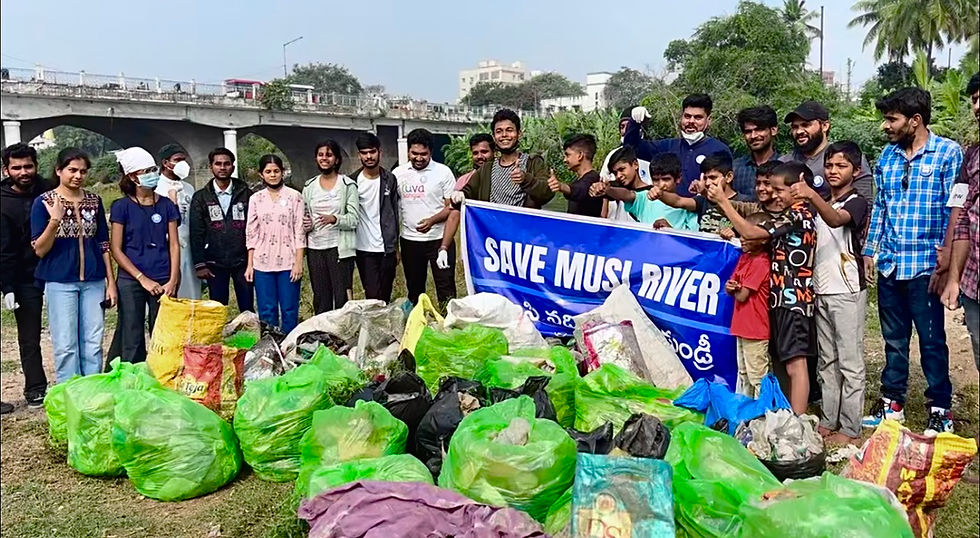
You can help the Save Musi Movement by spreading awareness about this issue, follow their Instagram channel and amplify their voices! Help this campaign achieve global attention to put pressure on local governments in order to not go ahead with the concretisation and re-development of the river bed and instead focus on the rejuvenation of the river. Help them go from the polluted river above, to the beautiful scene it can become below.


Comments