


World-Changing Kids
Kids Standing in Solidarity with Kebaowek First Nation
The Fight Against the Nuclear Waste Dump at Chalk River
by Lindsey Barr
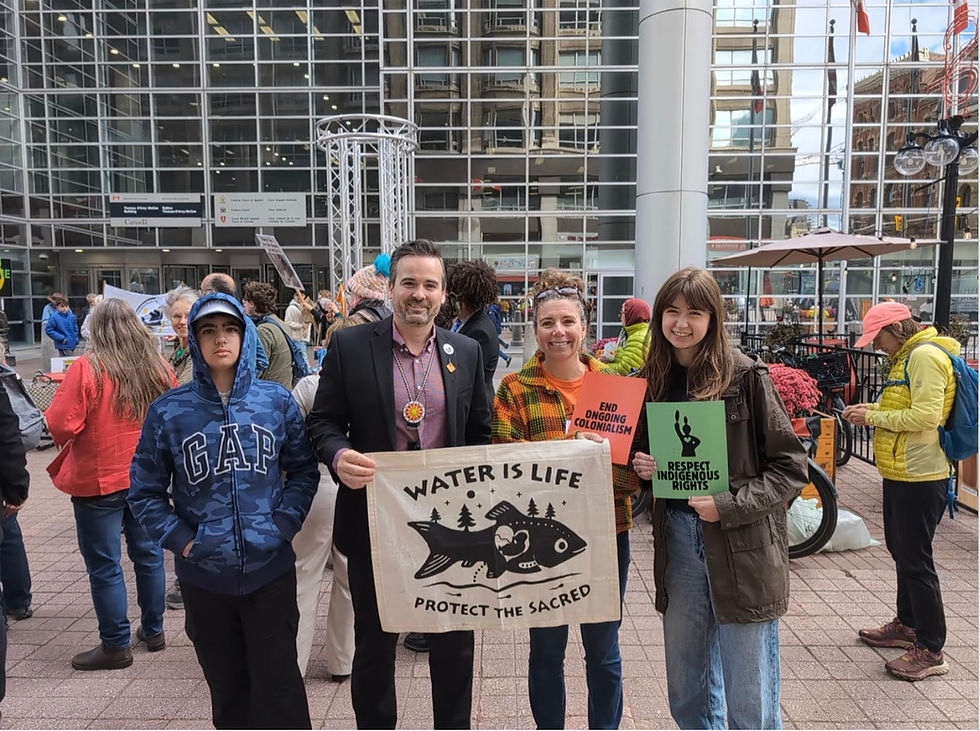
My name is Lindsey, and I am the Founder of World-Changing Kids (WCK): a grassroots organization dedicated to working with children to make the world a better place. Under this, I run the Upstanders Academy: an online social justice experiential learning program for youth ages 12 - 16. My Upstanders and I have some important learning and a call to action to share with you today!
Did you know that Kebaowek First Nation is currently fighting against a nuclear waste dump being built:
at Chalk River,
on their territory,
1.1 km from the Ottawa River - a drinking water source for millions of Canadians,
above porous and fractured bedrock - with high rates of groundwater flow into the Ottawa River,
that would require the destruction of 91 acres of old-growth forest,
in an earthquake zone?
This waste will remain radioactive, and therefore dangerous, for a very long time - some sources say upwards of 300 years, and others have said that the waste will remain radioactive for millennia.
And that’s not even the full list of complaints we have with this plan!
“Water is life! That is the truth. It makes me sad how many people take for granted the vital liquid that gives us the chance at survival on this planet we call home. Water gives us so much, and in return we should treat it with the same respect.” - Ruby, Upstander, age 16
“In my opinion, some politicians care about reconciliation but the majority of them do not. Lots of them make promises that they do not follow through. They pay lip service to reconciliation.” - Izzy, Upstander, age 14
You can watch this video that my Upstanders and I made for a more detailed explanation of the issue.
Background: Legal Challenge Details
Canadian Nuclear Laboratories (CNL) proposed a Near Surface Disposal Facility (NSDF) at Chalk River in 2016 to manage low-level radioactive waste. In January 2024, the Canadian Nuclear Safety Commission (CNSC) approved an amendment to CNL’s licence to allow construction of the NSDF. Kebaowek First Nation has stated that this approval occurred without adequate consultation and without their free, prior, and informed consent (FPIC), as reflected in the principles of the United Nations Declaration on the Rights of Indigenous Peoples (UNDRIP). For more information about UNDRIP, you can watch this video that my Upstanders and I made.
In February 2024, Kebaowek First Nation filed an application for judicial review of the CNSC decision, arguing that the Crown did not fulfill its duty to consult and accommodate. In March 2024, a separate legal challenge was filed in relation to permits issued under federal species-at-risk legislation.
The case, Kebaowek First Nation v. Canadian Nuclear Laboratories, was heard in the Federal Court in July 2024. In February 2025, the Federal Court found that the CNSC’s decision was unreasonable because it failed to adequately consider UNDRIP in its assessment of whether the duty to consult had been met. The Court directed that consultation be resumed with Kebaowek First Nation, with a view to implementing UNDRIP principles, including FPIC, in a meaningful way. The renewed consultation process is to be completed by September 30, 2026, after which the CNSC must reconsider its decision.
In relation to the judicial review under the federal Species at Risk Act, the Federal Court found that the responsible authorities failed to consider “all reasonable alternatives” when selecting the proposed site for the NSDF. The assessment focused primarily on lands owned by Atomic Energy of Canada Limited (AECL), without adequately considering whether alternative locations outside of AECL-owned lands could reduce impacts on species at risk and their habitat.

Following these decisions, Canadian Nuclear Laboratories (CNL) filed appeals of the Federal Court rulings, and Kebaowek First Nation filed a cross-appeal. These appeals were heard by the Federal Court of Appeal on October 8, 2025. A Rally of Allies for Court Support was organized for this date to demonstrate that communities, civil society, and leaders across sectors remain committed to protecting water, biodiversity, and Indigenous rights. A decision from the Federal Court of Appeal is currently pending.
Our Call to Action

My Upstanders and I attended the Rally of Allies for Court Support to stand in solidarity with Kebaowek. While there, we got to meet Leah Gazan, NDP MP for Winnipeg Centre, and out of the blue she said that we should work on a petition to the House of Commons about this issue. She said that if we can get 500 signatures on the electronic petition by the closing date of July 8, 2026, or 35 signatures on the paper petition, she would read it in the House of Commons and invite us to attend. We enthusiastically agreed to this plan.
We worked with Justin Roy, Councillor at Kebaowek First Nation, Levin Chamberlain at RAVEN, and Noah Kathen at Leah Gazan’s office on this petition and published it on March 10, 2026. We reached 500 signatures on March 24th, 2026!
You can access this e-petition here.
We also have a paper petition, which you can access here.
You can print this out and collect signatures from your community. Once you get 35 signatures, you can mail this in to Leah’s office. We got David Suzuki’s signature on our paper petition when he was here in Ottawa!

But getting the first 500 signatures on the e-petition is only the beginning of this work. We are now working with Justin to create a presentation that students from across Canada can use to talk to their class about this issue. They would then invite their classmates to sign the petition - either the electronic or paper form, write a letter to the Prime Minister using a template that we have created, and come up with other ways that they can help spread awareness about the nuclear waste dump and show their support for Kebaowek First Nation!
We are creating a powerful grassroots, youth-led movement to ensure we get the best solution for the storage of this nuclear waste. A solution that looks seven generations ahead with respect to protecting the water.


Comments